My mom left me a few assignments before she passed away. One resulted in a quilt series I made to honor the life of my grandfather, her dad. The second was an artwork about her grandmother, who was very influential in her life.
My Great Grandmother Sarah Kopel
My mom’s maternal grandmother, Sara Kopel nee Schinitzki, was born in Ozorków—then a part of the Russian empire, now in Poland—in 1865. She was the eighth of ten children of Avraham David and Kendla Schinitzki. In 1886 (or thereabouts) she married Mendel Layzer Kopel and moved with him first to Krynki (east of Białystok), and then, in 1907/8 to Łódź, a much bigger city and a textile center. The couple had ten children, but their youngest son died as a toddler. After her husband succumbed to the Spanish Flu in 1918, the family fell on hard times. Sarah and her older children had to work hard to support themselves. Most family members, like many other Jews in Łódź, labored in the textile industry, with Sarah specializing in gathering dowries for brides. Most of the children later married and had families of their own.
One of Sarah’s daughters, Hannah, moved with her husband to Jerusalem, then under the British-controlled mandate of Palestina-Eretz-Yisrael, in 1925. Eight years later they sponsored “certificates” (immigration visas) for Sarah and her youngest unmarried daughter, my future grandma Clara.

In 1933 Sarah and my grandma returned to our ancestral land and settled in the holy city of Jerusalem. Sarah lived with Hannah and her family, while my grandmother married and started a family of her own. When my mother was born, Sarah often took care of her. My mother remembered Sarah as a dignified, regal person. She was a devout, pious woman, who attended synagogue daily and who actively practiced Tzedakah (the Jewish value of righteousness and charity-giving), sharing with others the little she had. Some of my mom’s fondest childhood memories involved following her grandmother on her daily rounds to help the needy. Sarah told my mother numerous biblical stories, and taught her to be a good person. She was a huge influence on my mother, and my mother loved her dearly.
This is one of the rare pictures of Sarah in Jerusalem:

The Calamity of World War Two
After she moved to Jerusalem, Sarah kept in close touch with the seven children she left behind in Poland. That contact ended abruptly when WWII broke out. For several years, she heard vague rumors of what was happening in Europe, but like everyone else in the Holy Land at the time, didn’t know any of the details. I can only imagine how difficult those years were…
When the war ended, Sarah finally received a letter from one of her Polish granddaughters. The letter, sent from a refugee camp, contained the worst possible news. Of the tribe she left behind, her children and their families, only three granddaughters survived. Everyone else, seven children and their spouses, fifteen grandchildren, and one great-granddaughter, were murdered in the Holocaust. In one instant, Sarah learned that she had lost twenty eight immediate family members, not to mention many more of her extended family: siblings, cousins and their families.
My mother was a young child when the news came, and she did not remember what happened next. But this is the story she heard from her mother:
When Sarah received the news of the near-complete elimination of her family, she locked herself in her room in her daughter Hannah’s apartment. For seven days and seven nights, the duration of the Jewish Shiva, or week of mourning, she did not come out. She fasted, cried and screamed, and tore to pieces letters she got from her children and their pictures. When her week of mourning was over, she emerged from the room and uttered a quote from Job 1:21: “ה’ נָתַן וה’ לָקָח, יְהִי שֵׁם ה’ מְבֹרָךְ” (“the Lord gave, and the Lord has taken away; blessed be the name of the Lord“). She never mentioned any of them again.
Sarah passed away in Jerusalem during Israel’s War of Independence, in June 1948. She was buried in a temporary grave, until the unification of Jerusalem in 1967. Then, she was moved to her final resting place in the Mount of Olives Cemetery, to a plot she purchased immediately after immigrating to the holy Land, next to the graves of her father and father in law, who both came to Jerusalem long before she did, to die and be buried there.
The Quilt: A Sacred Work
The Planning
My mother asked me to make a quilt about her grandmother. She specifically asked to include her grandmother’s Shabbat candlesticks in that quilt. Sarah Kopel’s candlesticks were two very similar candlesticks, but they were not identical. They actually came from two alike-yet-different pairs. Sarah inherited one candlestick from her mother, and the other from her stepmother, who was also a relative. Since the family was poor, the candlesticks were made of cheap metal, but they were covered with a thin layer of silver. They were precious to Sarah, though, and were one of the few possessions she chose to bring with her from Poland. After Sarah passed away, the candlesticks went to my grandmother Clara, who kept lighting them every Friday night. She gave them to my mother, who saw them as one of her prized possessions, reminding her as they did of her beloved grandmother. My mother, too, continued to light them every Shabbat. In-between uses they were placed in a prominent place in her living room:

Before she passed away, my mom gave the candlesticks to my niece, her youngest granddaughter. In the picture below you can see both their hands lighting the candles together on one of my mom’s last Shabbats:

After my mom’s passing, I thought about this quilt for many months. I wanted to include a picture of Sarah, and the candlesticks, of course. But early on, I decided that the quilt must also include the names of Sarah’s murdered children, grandchildren and great-grand daughter, as they were an important part of her life. These people, my mom’s aunts, uncles and cousins, have no graves, and there are hardly any people alive today who remember them. I wanted the quilt to highlight Sarah, but also to honor my dead relatives, so that their names will not be forgotten.
I decided to use a dark blue background. I don’t know whether Sarah liked blue, but my mom always talked about how queen-like she was, and somehow blue seemed right. Also, in her official picture (the first picture in this post) she is wearing a dark velvet dress. I’ve always imagined this dress being blue. As for the names, I somehow felt they had to be written in silver. Blue and silver, close to the blue and white of many a tallit, the Jewish prayer shawl.
The Preparations
It took me months to gather all the materials I needed for this quilt. I started by having a picture of Sarah printed on canvas by a commercial fabric printer. I visited FabMo multiple times to find velveteen fabrics (a reference to Sarah’s dress) in the exact right shade of blue I had in mind. Finally, I gathered embroidery threads in silver. I couldn’t find a silver ribbon, though, until I stumbled onto one by chance at FabMo.

Once I had it, everything was ready. I kept procrastinating, however. Although I had a picture of the completed quilt in my head, I just couldn’t get myself to make it. It was somehow too emotionally difficult. Then, in spring 2023, after my trip to Croatia, I went back to Israel to visit my mom’s grave on the one-year anniversary of her passing. When I returned home I knew it was time.
The Making
I pulled out the blue background, a blank canvas. I printed the list of murdered relatives that my mom had sent me years before. Carefully I counted and calculated, then measured and drew lines.
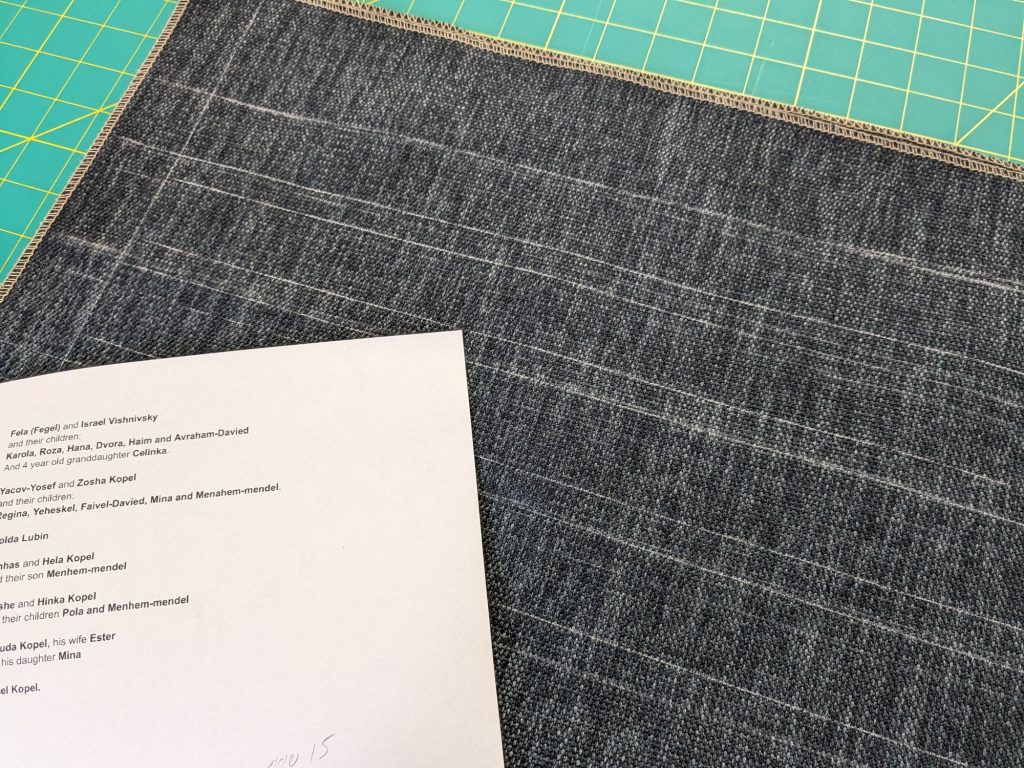
I began writing the names by hand. I could have used stencils, bur incorporating my own handwriting into this piece was important to me. These were my relatives, after all, and writing their names myself felt more personal and respectful.
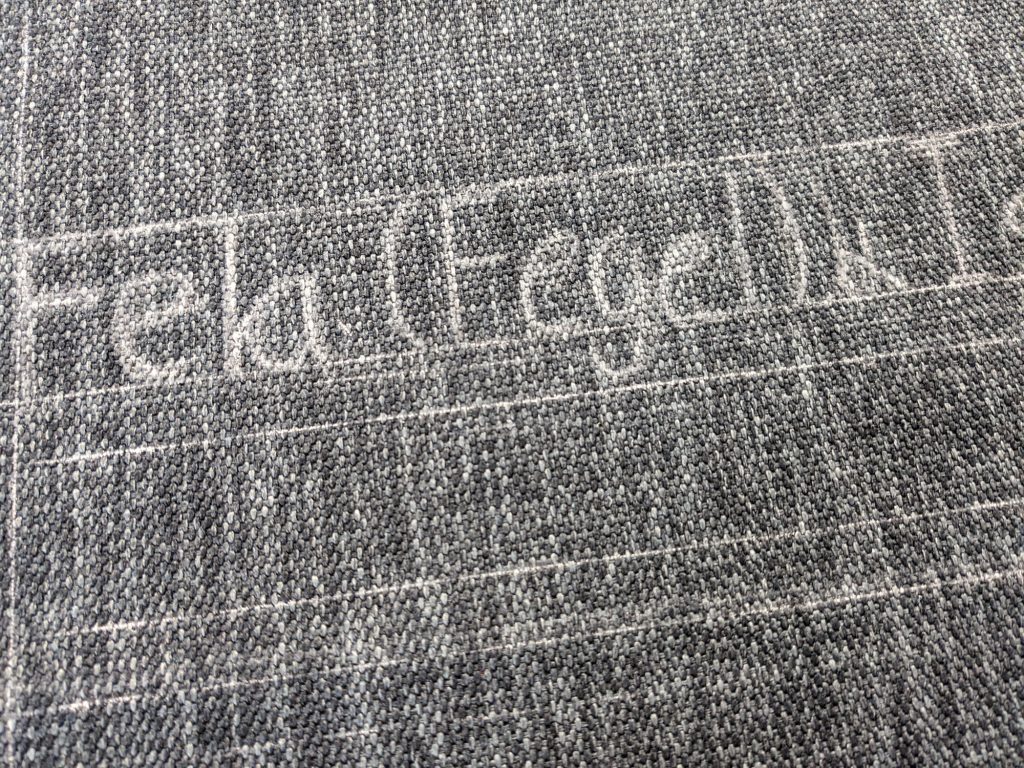
I carefully cut the silver ribbon and temporarily glued it around each letter of a name.
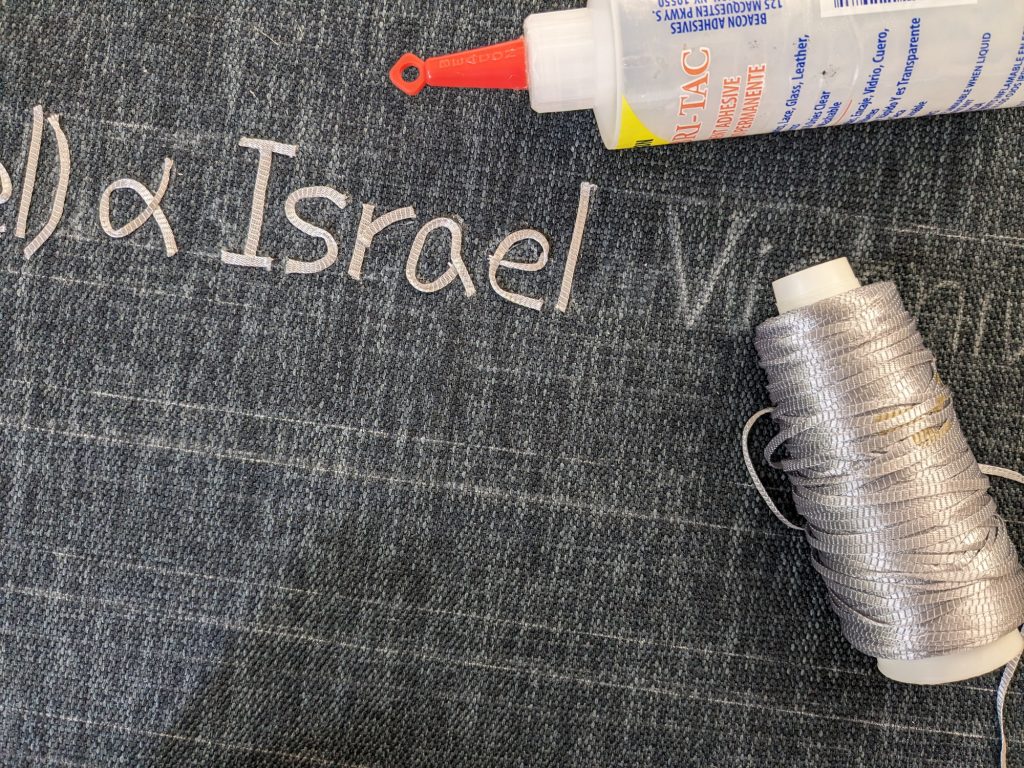
I embroidered the words that weren’t names with silver pearl cotton. This was very slow, careful work. I sometimes listen to podcasts while creating art in my studio, but this time I worked in complete silence. Making this quilt felt like performing a holy task. There was something very spiritual about it. For hours a day, I kept thinking of the great grandmother I never met, and about how she must have felt upon hearing of the near annihilation of her family. Having children of my own, I felt her pain deep in my gut. I thought of my own grandmother, of my mom whom I miss dearly, of the connections between mothers and daughters and the hidden ties that create families. I thought of my people and their suffering, and of the challenges we keep facing one generation after the next.

Slowly, a few lines a day, my list kept growing.
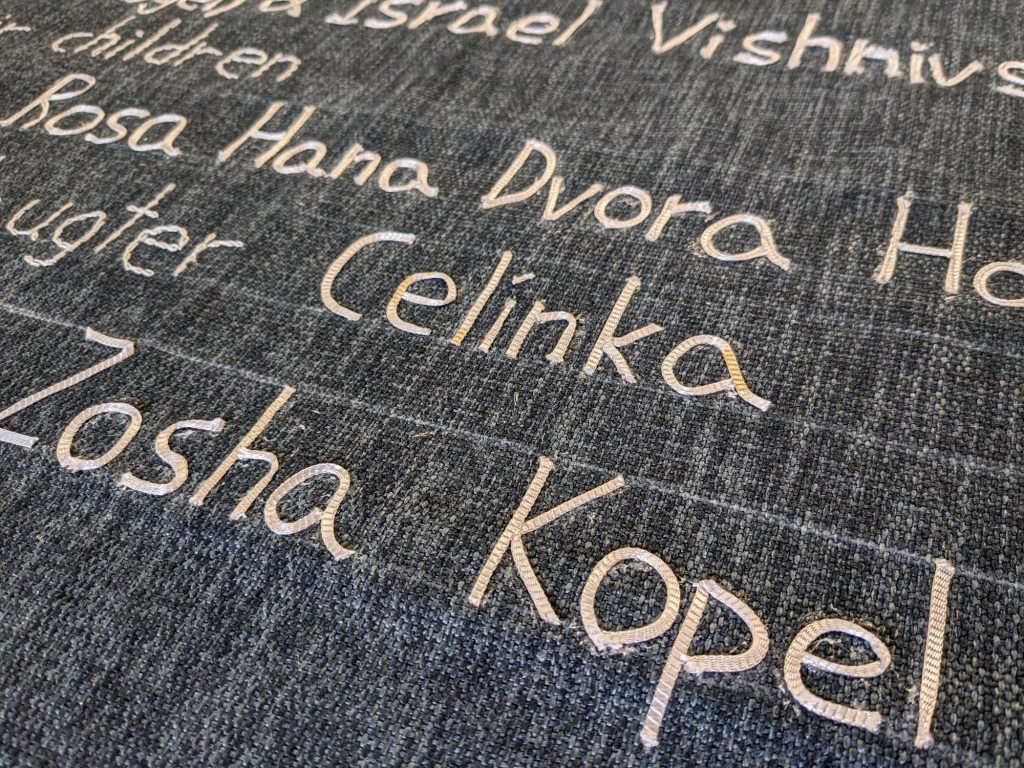
Name after name, of adults, teens, young children. I kept wondering how things could have been had there not been a world war, had the Nazis not decided to eliminate the Jews, had all these relatives gotten to live long, happy lives. My mother might have spent joyful times visiting relatives in Poland. I would have been a part of a much large tribe…
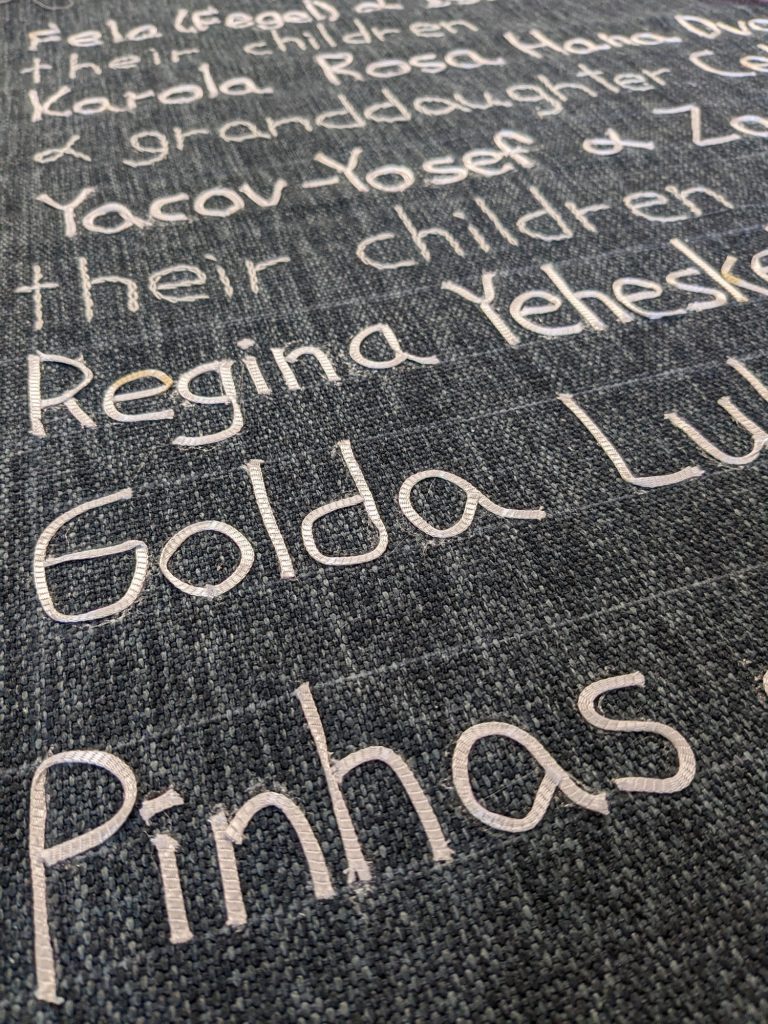
When the list was finished, I couched the ribbon onto the background using my sewing machine, and moved on to other parts of the composition. I sewed on my great grandmother’s picture. Then, I cut the candlesticks out of the picture I had printed, painted them silver and attached them, too.

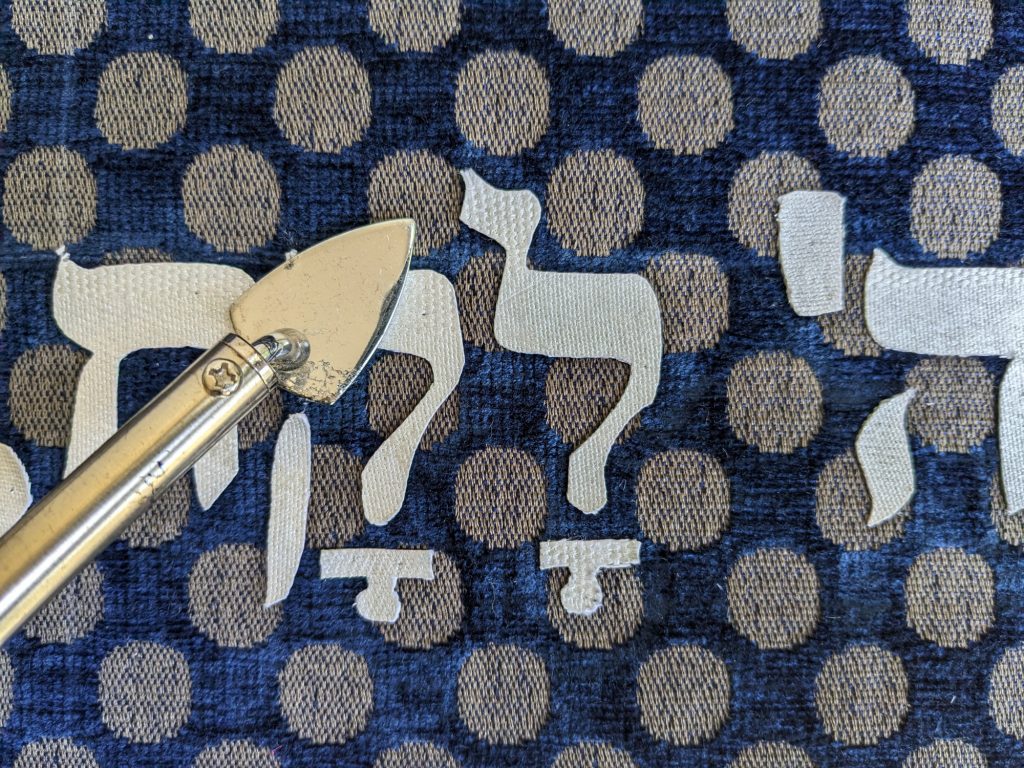
For the near-last step, I painted canvas in silver, and cut out the quote from Job that my great grandmother used when she emerged from her Shiva.
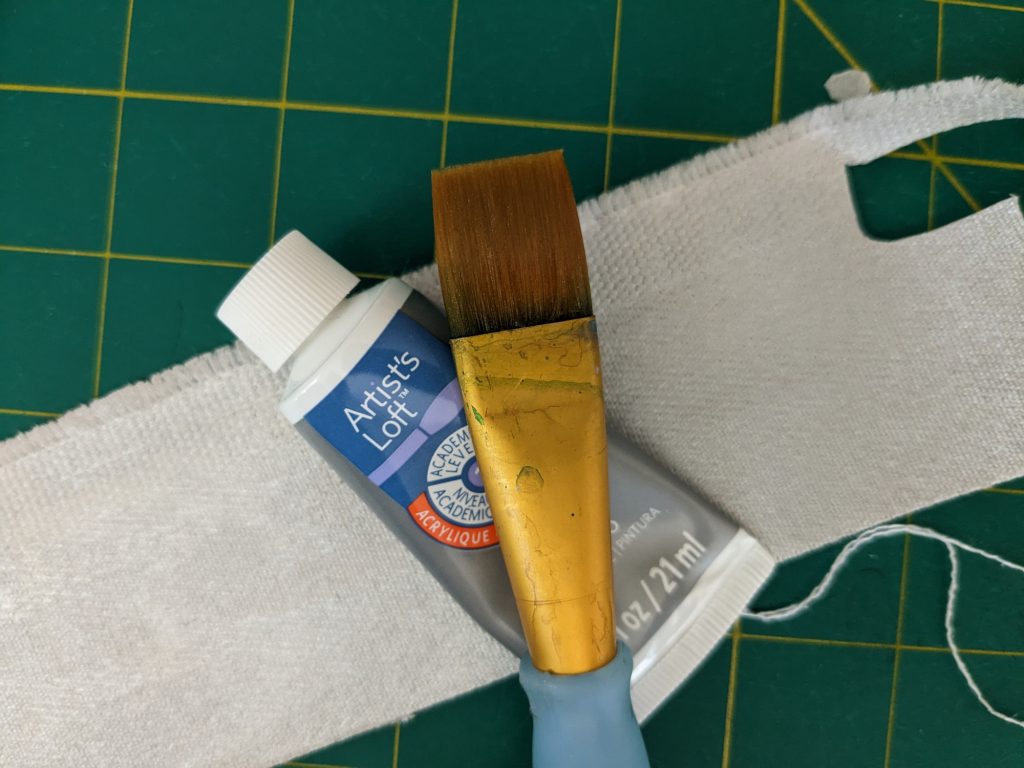
I fused it onto the quilt, before stitching it down.
After all the main components were finished, I added burning candles to the candlesticks. Shabbat candles, like the ones lit in these specific candlesticks for five generations and counting, symbolizing the continuation of my family despite the efforts to destroy it. But these are also a reference to yahrzeit candles (Soul Candles) that now burn permanently under the names of our dead. Even though we never got to meet them, the living members of my family remember.
The finished artwork, which I called “The Grieving Matriarch,” is 41″ x 45.”

This quilt was juried into SAQA’s Bearing Witness exhibition, which opens on August 28, 2024 at the Institute of Holocaust and Genocide Studies at Raritan Valley Community College in Branchburg, NJ. The exhibition will tour in various venues throughout the US for the next three years.
Thank you for sharing the story of Sarah and your family. Your quilt is a wonderful tribute.
Gayle
Thank you Gayle. It wasn’t easy to make this piece…
Svia, Thanks for sharing this powerful story in words and in cloth! I’m happy it will be shared wirh many! A beautiful accomplishment. All the best!
Thanks so much, Becky! I think my mom would have been pleased to know it will tour with this touching exhibition.
Very moving and a wonderful tribute, I hope it gave you some closure pertaining to all the older and more recent tragedies.
Thank you! I’m not sure about the closure part. Some things are just too horrible to fully get over.
Wow, a powerful story and a powerful quilt!
Thank you, Claire! It emotionally drained me after I made it.
One can feel the powerful spiritual weight of this quilt. What it took to make it, what it took Sarah and the rest of her/your family to survive it. It is beautiful, powerful, and devastating all at the same time. I honor the courage and deep love it took for you to create this quilt. Thank you for sharing it with the world so we can bear witness!
Thank YOU for bearing witness! That, too, is a difficult thing to do. I am grateful for your kind words!
Zwia, your words, along with this breathtaking quilt, are a work of art. Thank you for bringing Sarah into our hearts and minds and memories, and bringing us into your journey of hands and heart.
Thanks for helping me keep their memories alive, Colette. There are so many who have been forgotten.
Hi Zwia, I am awed by your devotion to the memory of your dear grandmother. I imagine she is proud beyond measure. Thank you for sharing. I am inspired to recognize my own family.
With love, Mary
I’m so happy this inspired you to recognize your own family! Our ancestors are an important part of who we are, and deserve to be remembered!